On this page7
flowkey vs Simply Piano
Both are well-made subscription apps that listen to you play and give instant feedback. Simply Piano leads with a structured, step-by-step course and suits people who want to be told exactly what to do next. flowkey leads with its song library and suits people who already know which songs they want to play. Neither is a bad choice; the mismatch is what causes drop-off.
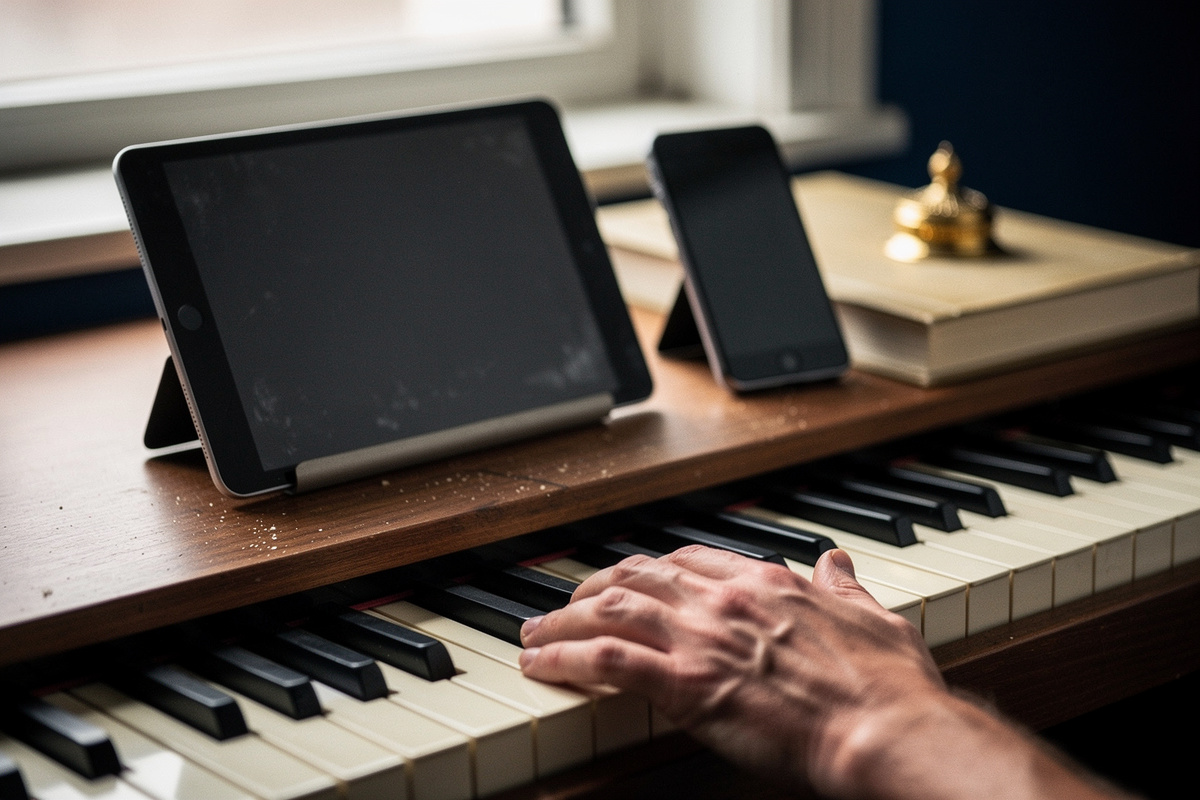
This comparison is written for the specific case this site is about: an adult beginner, practising roughly twenty minutes a day at home, with no teacher. We have no commercial relationship with either app, and neither is linked here.
The short answer
Choose Simply Piano if you're starting from zero, you don't yet know what "learning piano" should look like day to day, and you want a path that opens the next step for you. Its lesson ladder and progress tracking do a lot of the decision-making that otherwise stalls beginners.
Choose flowkey if you have a list of songs you want to play, or some prior music background, and you'd rather browse a catalogue than follow a curriculum. Its song-first design and adjustable practice tools suit self-directed learners.
Feature comparison
| flowkey | Simply Piano | |
|---|---|---|
| Core approach | Song-library first, with courses available alongside | Course first, with songs unlocked along the path |
| Structure | You choose what to learn next | Guided step-by-step levels |
| Feedback | Listens as you play and waits for the right notes | Listens as you play and scores each attempt |
| Notation | Sheet music plus a video of the hands | Notation introduced gradually through the levels |
| Practice tools | Slow-down, loop sections, hands separately | Slow-down and repeat within lessons |
| Setup | Acoustic or digital piano via microphone; MIDI supported | Acoustic or digital piano via microphone; MIDI supported |
| Feel | Calm, catalogue-like | Gamified, streaks and scores |
| Pricing model | Subscription, with a limited free tier — check the current price | Subscription, usually with a trial — check the current price |
| Best for | Self-directed learners with songs in mind | Complete beginners who want to be led |
Prices and trial terms change often and vary by region, so check each app's own page before committing rather than trusting any number you read in an article.
How they teach, in practice
Simply Piano
Simply Piano is built as a ladder. You take a short placement, land on a level, and work through short lessons that each add one small thing. The app listens, scores your attempt, and moves you on when you're accurate enough. For an adult who has never played, that removes the hardest question — "what should I do tonight?" — which is exactly where most home learners stall.
The trade-off is that the path is the path. If you want to spend a fortnight on one particular song, the structure isn't really designed for that, and some adults find the game-like scoring more motivating in month one than in month six.
flowkey
flowkey puts the song library at the front. You pick a piece, filter by difficulty, and work on it with a split view: a video of someone's hands above, notation below. You can slow the tempo, loop a section, and practise hands separately, which maps well onto how you'd actually learn a piece.
The trade-off is that it assumes you'll direct yourself. Its courses cover the fundamentals, but nothing pushes you to do them. A beginner who browses the catalogue, picks something too hard, and gives up will conclude the app didn't work — when really the sequencing was the missing part.
What both do well
- Instant feedback. Hearing "that note was wrong" immediately is genuinely valuable, and it's the main thing self-study books can't do.
- Low friction. Open the app, and a session is ready. For a twenty-minute habit, that matters more than feature lists.
- They work with the piano you have. Microphone listening means you don't need to buy a MIDI cable to start, though MIDI is more reliable if your keyboard supports it.
What neither one solves
- Technique. Note detection can tell you which key you hit, not whether your wrist is tense or your fingers are collapsing. Occasional video of your own hands, or a single lesson with a teacher, fills that gap cheaply.
- Deep sight-reading. Both introduce notation, but neither replaces steady reading practice. See how to read sheet music.
- The habit. A streak counter is not a routine. The app can't decide that 8pm is practice time; you have to.
The self-study alternative
Subscriptions suit people who like a nudge and don't mind a recurring bill. If you'd rather pay once and work at your own pace, a chords-first course covers similar ground in a different shape. Piano For All is the one we'd point an adult beginner at — it teaches chords and rhythm early so you're playing songs quickly, and it's a one-time purchase rather than a subscription. It gives no live feedback at all, which is the honest trade against both apps. Our Piano For All review sets out where it falls short.
How to decide tonight
Write down the three songs you most want to play. If they're specific, well known, and you can picture yourself practising them for weeks, flowkey's catalogue approach will suit you. If the list is vague, or the honest answer is "I just want to be able to play the piano," take the guided route with Simply Piano. Then use the free trial period properly: practise every day for a week, and judge the app on whether you came back on day five — not on how good the first lesson felt.
Whatever you choose, the app is the smaller half. See our wider look at apps versus courses and pair the tool with a real routine.